


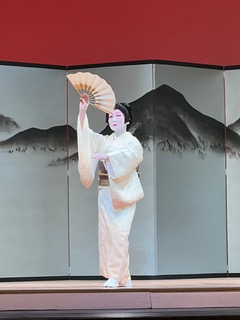

Performers and sensei Bando Hidesomi (center left) and sensei Bando Hideko (center right) from Japan.
Bando Hidesomi marks 30th anniversary with “Yuubi” at The Aratani.
By TOMOKO NAGAI
Rafu Staff Writer
Los Angeles–based Japanese classical dancer Bando Hidesomi presented her recital, “Yuubi: Elegance and Grace of Nihon Buyo,” on Jan. 17 at the Aratani Theatre in Little Tokyo.
The performance was conceived as the culmination of 30 years of teaching, creative work, and cultural outreach that Hidesomi has steadily built in Los Angeles. Centered on classical repertoire, the program vividly demonstrated the essence of Nihon buyo through emotionally rich movement and carefully structured contrasts in tempo and composition.
Four New Natori
“Yuubi” consisted of 12 works, each independent yet collectively structured to convey the intrinsic beauty of Nihon buyo as a whole. Performers included Hidesomi herself; her teacher, Mme. Bando Hideko, who traveled from Japan to appear as a special guest; newly certified natori (professional stage-name holders); and many disciples, including children. The program ranged from major traditional kabuki dance works to original group choreography.
The harmony between stage design and lighting — prepared with specialists invited from Japan — along with authentic costumes, left a strong impression. In every sweep of the hem and every use of the fan, one could sense a finely polished aesthetic sensibility, drawing audible admiration from the audience throughout the theater.
Hidesomi describes Nihon buyo as “a performing art that embodies elegance and grace,” and she aimed to allow audiences to naturally feel its essential beauty. The result of projecting her own philosophy of Nihon buyo onto the entire production is encapsulated in the title “Yuubi.”
In selecting the program, she considered audience enjoyment, but what she emphasized most was the individuality of each disciple. For those making their natori debut, she selected works that would allow them to dance comfortably while also offering artistic growth. She believes that drawing out the fullest charm of each performer contributes to the overall completeness of the recital.
The four new natori were:
Stephanie Aki Nakatomi as Bando Hideakiyo, who performed the nagauta piece “Shiokumi”;
Aly Mayumi Minamide as Bando Hidoreimi, who performed “Yashima Kanjo”;
Lauren Minako Parham as Bando Hideshizumi and Konami Masui as Bando Hideyoshina, who performed “Renjishi” as the parent and child lions.
Behind-the-Scenes Artists
What was emphasized in the stage production was that Nihon buyo is not an art sustained by dancers alone. Makeup, costumes, wigs, stage sets, backdrops, and lighting — all contribute to its realization as a total art form. The high level of completion as a comprehensive art form gave birth to “Yuubi.”
For this reason, staff thoroughly versed in Nihon buyo staging were invited from Japan, and meticulous attention was paid to color and lighting details. One anecdote noted that the paint color for the backdrop could not be reproduced using American paint-color samples, symbolizing the distinctive color sensibilities unique to Nihon buyo and kabuki.
In stage management, production staff familiar with both Japanese and American practices served as bridges, working closely with local crews. Clear divisions of responsibility for stage sets, progress cues, and timing ensured that the performance was supported by the collective efforts of many individuals.
In addition to preparations for makeup (kaoshi), costumes (isho), and wigs (tokoyama) backstage, members of the Bando-ryu school traveled from Japan to assist onstage as well. In “Renjishi,” they operated butterfly props; in the Kiyomoto piece “Omatsuri” (danced by Bando Hiroharumi), one performed lively supporting roles as young man of the festival.
As koken (stage assistants who support the dancers onstage) and karami (supporting roles who interact with the main performer), they demonstrated flawless movement. In total, 14 people traveled from Japan to support the production.
Connecting to the Next Generation
Though the performance lasted more than four hours, many audience members commented afterwards, “I couldn’t take my eyes off it,” “It was simply beautiful and enjoyable,” and “My impression of Nihon buyo has changed.”
In addition to the beauty of color, costume, and makeup, many remarked that they could feel the dedication of the disciples. Even audience members unfamiliar with Nihon buyo were left with a strong impression.
Regarding her teaching, Hidesomi says she has emphasized the attitude of “giving 110 percent on stage” of what has been learned in daily training. Her own performance of “Kane no Misaki” ultimately became the symbolic conclusion of “Yuubi,” once again demonstrating that Nihon buyo is an art that is studied and pursued over a lifetime.
Moving forward, grounded in gratitude toward the community that has supported her, she aims above all to continue and to pass down not only dance itself but also the experience of creating such performances to the next generation.
Each Work Filled with Meaning
Each work presented embodied Hidesomi’s intention. The opening piece, “Fuji,” danced by her teacher Bando Hideko, was a short piece expressing hopes for the continued development of the Bando school, dedicated to the sacred Mt. Fuji. The program notes state that “for this reason, the guild name Yamatoya is woven into the lyrics.” The piece was choreographed during his lifetime by the 10th headmaster, Bando Mitsugoro.
The nagauta piece “Shinhitotstuoya,” danced by five performers dressed as geisha (Bando Hiromisa, Mitsue Kajikawa, Tamami Nagasawa, Sayumi Nishio, and Mieko Roaming), faithfully recreated choreography by late Bando Mitsuhiro, Hidesomi’s teacher in Los Angeles. Holding decorative mayudama ornaments, their dancing vividly portrayed the atmosphere of New Year’s traditions.
Meanwhile, the Yamatogaku piece “Hanafubuki,” performed by Sophia Kureha Armstrong, Samantha Kotomi Hata, Lio Itaya, Julia Kirsten, Leia Kazusa Koppers, and Miako McGibbony, evoked a more contemporary style of Japanese dance reminiscent of the Nisei Week Queen Coronation Ball choreographed by Hidesomi each summer.
Children charmed the audience in the nagauta piece “Hanakurabe” (Saydee Rie Chan, Hinata Lim, Hinoki Stevens, Courtney Mieko Su, and Emma Narumi Tanaka), and in the Kiyomoto piece “Sakura” (Grant Nakano), celebrating the beauty of Japan’s seasonal nature.
In contrast, the second-half opening dance of nagauta piece “Yutaka” (Bando Hiromisa) shifted the mood to a world reminiscent of monochrome ink painting and the aesthetic of wabi-sabi.
”Renjishi,” the Dynamic Lion Dance
The essence of Bando school kabuki dance tradition was fully displayed in works such as “Fuji Musume” (Sophie Manami Kawakami), featuring a magnificent backdrop of wisteria trees; the Kiyomoto piece “Omatsuri” (Hiroharumi), depicting Edo-period festival culture; the new natori performances of “Shiokumi” (Hideakiyo), “Yashima Kanjo” (Hidoreimi), and “Renjishi” (Hideshizumi and Hideyoshina). These works powerfully captivated the audience.
Among them, the greatest highlight was “Renjishi.” During appearances of two young girls — Ellie Natsumi Kawakami and Kyoka Stevens — performing the innocent role of butterflies (kocho), came the dramatic quick change from kyogen-shimen into lion spirits adorned with bold kumadori makeup.
As Hideshizumi and Hideyoshina performed the powerful hair-tossing movements of the father lion in white and the cub in red, excitement swirled through the theater.
30 Years Embodied in Finale
In contrast, the finale featured Hidesomi dancing the Ogie-bushi piece “Kane no Misaki” (choreographed by the eighth Bando Mitsugoro) with luminous elegance. That elegance permeated every detail, reaching into the smallest gestures and even the sweep of her costume’s hem.
Not only did her own dancing shine, but the performances of her disciples were equally refined, and the weight of the years built together by teacher and students was deeply inscribed upon the stage. The standing ovation, whistles, cheers, and applause offered by the audience — rare in the world of classical Japanese performing arts — generated a uniquely American atmosphere of enthusiasm.
In multicultural Los Angeles, “Yuubi,” which celebrated Bando Hidesomi’s journey, clearly demonstrated the authentic power of the art itself and the enduring vitality of traditional performing arts that continue to live and breathe across national borders.
“Every Single Movement Has Meaning”
Hidesomi’s teacher, Bando Hideko, 68, daughter of the ninth headmaster, Bando Mitsugoro, has guided her since she was in elementary school, accepting her as an apprentice in the U.S. For this performance, Hideko traveled to Los Angeles early, overseeing rehearsals — including full dress rehearsals — and watching over the production.
She confirmed every student’s rehearsal, the same role she took at Hidesomi’s first recital. She also performed in the opening nagauta piece “Fuji,” and afterwards supported the production behind the scenes until the end.
Their first meeting took place when Hidesomi was still a young child. They met through Bando Mitsuhiro, who had been teaching Hidesomi during a visit to the U.S. Thereafter, Hideko assumed responsibility for her instruction. Every summer vacation, Hidesomi returned to Japan for training, and when she reached university age, she studied abroad in Japan.
At that time, studying in Japan from overseas was still uncommon, but after being persuaded of its significance, Hidesomi agreed and came to Japan. She lived for about five years under the ninth headmaster, Bando Mitsugoro, who cared for her deeply.
Reflecting on Hidesomi being born overseas, Hideko said, “I hardly ever thought of her as a foreigner.” She was surrounded by a Japanese-language environment, and “my father cherished her greatly,” she added.
In her instruction, Hideko emphasized firmly establishing technique first, and allowing Hidesomi to gain multiple stage experiences during her stay in Japan, which later proved invaluable.
Regarding the late Bando Mitsuhiro, she recalled that although she did not speak English, she devoted herself to spreading the art in the U.S. and trained many natori, excelling especially in foundational instruction.
Of Hidesomi’s present accomplishments, Hideko commented, “Just one word — happy,” and added jokingly, “In technique she has not yet surpassed me, but as a teacher she already has.” She said that Hidesomi’s dedication to continuing to teach many disciples itself demonstrates her strength as a performer. She highly praised her lifelong commitment and determination to continue studying Nihon buyo.
She also remarked that it was “impressive” that the disciples danced as if the works were truly their own. Though they may have fewer stage opportunities than in Japan, they danced with joy, possessing the most essential quality required to stand on stage. She emphasized that the natori debut is an important milestone in passing tradition to the next generation.
The core of Bando school dance, she stated, is that “every single movement has meaning.” This philosophy, nurtured together with kabuki, must be treasured. She strongly hopes that disciples will continue to preserve and dance with understanding of that meaning.
To see what she has taught continue to live on, even if passed down by only a few, is, she said, her greatest joy as a Japanese person.